|
       
| |
|
COSTA
SIERRA SELVA |
|

|
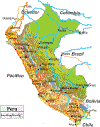
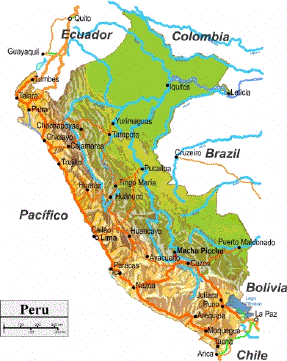
Peru is in
the west central part of South America, bounded on the north by
Ecuador and Colombia, on the East by Brazil and Bolivia, on the South by Chile and
on the west by the Pacific Ocean. It has an area of 1.285.216
km (496,225 miles) |
|
Geography:
There
are three natural zones running roughly north to south: Costa (Coast),
Sierra (The Highlands) and Selva (Amazonian Jungle).
Climate:
The climate varies according to
the area. January is the first full summer month with really nice weather.
It is hot,
but not too much; however, it brings heavy rains in the mountains and jungle areas.
Winter on the coast lasts from June to September. During this period, the
mountain areas are often sunny.
Capital:
The capital Lima
was founded
January 18, 1535.
Population:
The
population is approximately 26
million. It is largely Indian and Mestizo with a
noticeable influence from European (mainly Spanish), Asian and African
settlers.
Language:
Spanish and Quechua
are the official languages. Aymara and many other dialects are spoken
in some areas of the department of Puno and the jungle regions. English is
spoken in major tourist areas.
Official
Religion:
Catholic is the
official religion. All Catholic holidays are observed nationwide.
Government:
Peru
is
a republic governed by a constitution promulgated in 1993. This
constitution replaced the 1980 constitution, which was suspended in 1992.
The new constitution increased the power of the executive and allowed for
the reelection of the president to a second term. It also unified the
formerly bicameral legislature.
Time:
Peruvian time
coincides with Eastern Standard Time in the U.S. and is five hours behind
G.M.T.
Principal
exports:
The principal
exports are minerals,
petroleum, coffee, cotton, alpaca wool and fish products.
Weight
& Measures:
Kilograms and the metric
system are used.
Electric
current:
220 v is the
current used in Peru. |
You can see many pictures of my
country in three different regions:
|
 |
|
